Water Extraction & Removal in Sterling Heights, MI
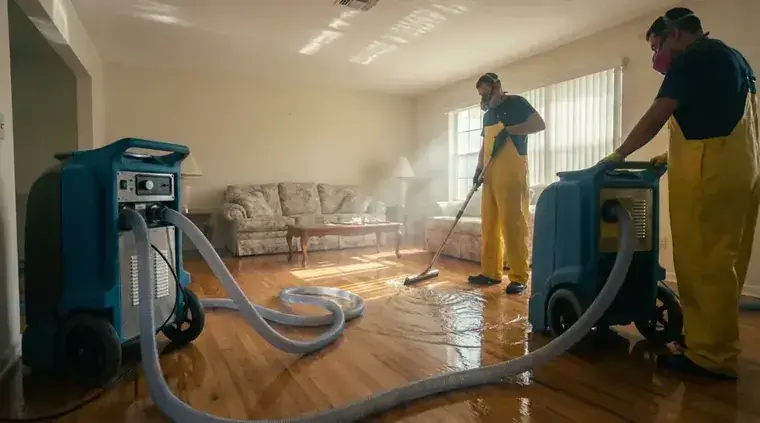
Every dry-out starts with getting the water out. The extraction crew pulls standing water with truck-mounted extraction, so it leaves the house instead of soaking into pad, drywall and subfloor.
(888) 612-9219Get water extraction started in Sterling Heights- Truck-mounted extraction
- Weighted carpet extraction
- 24/7 dispatch
What to do first about water extraction in Sterling Heights
- 1
Stop the source
Shut the main water valve, usually in the basement near the front wall.
- 2
Cut wet circuits
If the panel is dry, switch off power to rooms with water.
- 3
Lift and move
Pull rugs, boxes and furniture off the wet floor.
- 4
Call for extraction
Photograph the rooms, then call before the water spreads.
What does water extraction and removal cost in Sterling Heights, MI?
In Sterling Heights, MI, water extraction typically runs $500 to $4,000 on its own, and $1,500 to $7,000 when the drying that follows is included. The drivers are the square footage, the depth of the water, the flooring type and the water category.
One room
$500 to $1,200
- Extraction
- Pad check
- Moisture readings
Several rooms or a basement
$1,200 to $2,500
- Truck-mounted extraction
- Carpet and pad decisions
- Setup for drying
Deep or contaminated water
$2,500 to $4,000+
- Submersible pumping
- Category 2 or 3 handling
- Material removal
Ranges move with the water category, the square footage, the material class and how fast drying started. For a planning number, try the Sterling Heights water damage cost calculator.
Extraction is the cheapest part of drying. A gallon pulled out as liquid is a gallon the dehumidifiers never have to pull out of the air. That is why the extraction crew works fast and thorough before any air movers go down.
What gets extracted
- Standing water on basement slabs and in finished lower levels
- Water held in carpet and pad, with weighted extraction tools
- Water on hardwood and laminate, with floor tools and drying mats
- Water in crawl spaces and under tri-level stairs
- Water in commercial carpet and tile along Van Dyke and Hall Road
How extraction works
Truck-mounted extraction units sit outside and run hoses into the house. They pull water harder than a shop vac and send it out of the building instead of into a tank that has to be carried up the basement stairs. For deep water the crew uses submersible pumps first, then extraction wands.
On carpet, a weighted extraction tool presses water out of the pad as the crew moves across the room. On hardwood, specialty floor tools and drying mats pull water from the seams and the subfloor below. The tech who does the walkthrough uses meters to see where the water went beyond what is visible.
Trade fact: the category of the water decides what can be extracted and kept. Carpet and pad touched by Category 3 water are removed, not extracted and dried.
After extraction
Air movers and LGR dehumidifiers go in, sized to each room, and readings are logged daily. See structural drying for that phase. CDC flood safety pages cover health risks, and OSHA flood cleanup covers electrical hazards around standing water.
How water extraction is handled in Sterling Heights, MI
Every step follows the IICRC S500 drying standard, and each one leaves a record for the claim file.
- 1
Map the moisture
The tech who does the walkthrough maps moisture with pinless meters and thermal imaging before any equipment goes down, and sets the category and class of the loss.
- 2
Extract
The extraction crew pulls standing water with truck-mounted extraction, so it leaves the house instead of soaking further into slab, carpet pad and bottom plates.
- 3
Dry the structure
The drying team sets air movers to each room's evaporation load and runs LGR dehumidifiers, or desiccants for Class 4 materials like concrete block and hardwood.
- 4
Verify dry
Most crews pull equipment only when wet materials read within 2 to 4 points of a dry reference in the same house, with daily readings logged for the claim file.
Where the Sterling Heights water extraction crew works
The Sterling Heights restoration crew covers the whole city, from the Warren border at 14 Mile north to Hall Road, and from Dequindre east to the Clinton River and Dodge Park, plus the Macomb County towns around it.
See every side of town and ZIP codeWater Extraction and Removal questions in Sterling Heights
Short answers to what Sterling Heights homeowners ask most about water extraction.
Can I extract the water myself with a shop vac?
A shop vac helps with small amounts, but it cannot pull water out of pad and subfloor. Truck-mounted units move far more water and exhaust it outside.
How much water can truck-mounted extraction remove?
It depends on the unit, but it pulls water much faster than portable equipment, which shortens drying time.
Will extracting save my carpet?
Often, when the water is clean and extraction starts early. The pad is usually replaced.
Do hardwood floors need special extraction?
Yes. Floor drying mats and panels pull water from the seams and the subfloor, which helps prevent cupping.
What happens after extraction?
Structural drying with air movers and dehumidifiers, with daily readings until the materials reach the drying goal.
How fast does extraction need to start?
As soon as possible. Water keeps wicking into drywall and framing, and mold can start in 24 to 48 hours.
Water Extraction and Removal in Sterling Heights? Get the drying started today.
Every hour water sits pushes it deeper into carpet pad, drywall and the slab. The Sterling Heights restoration team works around the clock.