Structural Drying & Dehumidification in Sterling Heights, MI
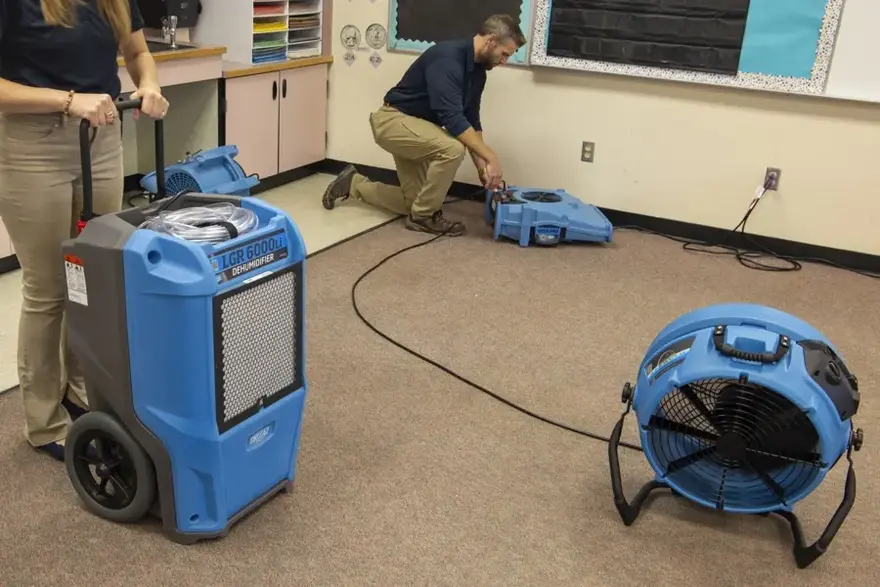
Surface dry is not dry. The drying team sets air movers and LGR dehumidifiers to each room's load and keeps them running until the framing, subfloor and walls read within the drying goal.
(888) 612-9219Get structural drying started in Sterling Heights- LGR and desiccant units
- Daily moisture readings
- 24/7 dispatch
What to do first about structural drying in Sterling Heights
- 1
Keep it closed
Keep doors and windows shut so the dehumidifiers can work.
- 2
Leave equipment running
Do not turn off air movers or dehumidifiers overnight.
- 3
Keep the heat steady
Hold the thermostat around normal room temperature.
- 4
Ask for the readings
Ask to see the daily readings and the drying goal.
What does structural drying and dehumidification cost in Sterling Heights, MI?
In Sterling Heights, MI, structural drying typically runs $1,200 to $7,000, depending on the class of the loss, how many rooms need equipment and how many days it takes to reach the drying goal.
Class 1 or 2, one area
$1,200 to $2,500
- Air movers and one LGR unit
- Three to four days
- Daily readings
Several rooms or a basement
$2,500 to $4,500
- Multiple LGR units
- Wall cavity drying
- Drying log
Class 4 materials
$4,500 to $7,000+
- Desiccant dehumidifiers
- Hardwood mats or block walls
- Extended monitoring
Ranges move with the water category, the square footage, the material class and how fast drying started. For a planning number, try the Sterling Heights water damage cost calculator.
Structural drying is the part of the job that decides whether a water loss comes back as stains, odor or mold. It is also the part most often cut short, because a floor can look dry days before the framing and slab under it are.
How structural drying works
The tech who does the walkthrough maps the moisture and sets the class of the loss, from Class 1 with little water absorbed to Class 4 with dense materials like concrete, block and hardwood. The class sets how many air movers and dehumidifiers each room needs.
- Air movers placed along wet walls to move air across the surfaces
- LGR dehumidifiers pulling moisture out of the air to keep evaporation going
- Desiccant dehumidifiers for Class 4 materials and cold basements
- Wall cavity drying through small holes at the base of the drywall
- Floor drying mats for hardwood
Reading the drying, not the calendar
Each day the drying team takes readings at the same marked points and records temperature and humidity. Equipment is moved as areas dry and comes out when the wet materials read within 2 to 4 points of a dry reference material in an unaffected part of the same house.
Basements in Sterling Heights often dry slowest. Concrete block walls and thick slabs release water gradually, and the ground outside is often wet clay. That is why the drying team keeps a basement closed and dehumidified instead of opening windows.
Trade fact: the drying log, with daily readings and equipment counts, is part of the claim file and shows the adjuster why the equipment ran as long as it did.
When drying is done
Only after the readings reach the goal does rebuild start. EPA indoor air quality pages explain why humidity control matters, and EPA advice on moisture in the home covers how water moves through a house. The drying-time estimator gives a typical window.
How structural drying is handled in Sterling Heights, MI
Every step follows the IICRC S500 drying standard, and each one leaves a record for the claim file.
- 1
Map the moisture
The tech who does the walkthrough maps moisture with pinless meters and thermal imaging before any equipment goes down, and sets the category and class of the loss.
- 2
Extract
The extraction crew pulls standing water with truck-mounted extraction, so it leaves the house instead of soaking further into slab, carpet pad and bottom plates.
- 3
Dry the structure
The drying team sets air movers to each room's evaporation load and runs LGR dehumidifiers, or desiccants for Class 4 materials like concrete block and hardwood.
- 4
Verify dry
Most crews pull equipment only when wet materials read within 2 to 4 points of a dry reference in the same house, with daily readings logged for the claim file.
Where the Sterling Heights structural drying crew works
The Sterling Heights restoration crew covers the whole city, from the Warren border at 14 Mile north to Hall Road, and from Dequindre east to the Clinton River and Dodge Park, plus the Macomb County towns around it.
See every side of town and ZIP codeStructural Drying and Dehumidification questions in Sterling Heights
Short answers to what Sterling Heights homeowners ask most about structural drying.
How long does structural drying take?
A contained Class 1 or 2 loss usually dries in three to five days. Block walls, slabs and hardwood take longer.
Why can I not just open the windows?
Outside air is often humid, and in winter it chills the house. Closed rooms with dehumidifiers dry faster.
What is an LGR dehumidifier?
A low grain refrigerant dehumidifier that pulls more water out of the air than a household unit, even as the air gets drier.
When is a desiccant dehumidifier used?
For Class 4 materials like concrete, block and hardwood, and in cold basements where refrigerant units slow down.
How do crews know the house is dry?
They compare daily readings to a dry reference material in the same house. Equipment comes out when the wet materials are within 2 to 4 points.
Is the noise normal?
Yes. Air movers and dehumidifiers are loud, and they need to run day and night to work.
Structural Drying and Dehumidification in Sterling Heights? Get the drying started today.
Every hour water sits pushes it deeper into carpet pad, drywall and the slab. The Sterling Heights restoration team works around the clock.